Archive | Uncategorized RSS feed for this section

Tackling Brick Walls – the challenges of Circular Economies

19 May


From our observations following a recent discussion on Sustainability, we suggest that tackling the challenges head on is not an effective use of resources.


Given time and the natural inventiveness of citizens and enterprises, today’s brick walls will rot through their own irrelevance – a process that is being accelerated within digitalised economies.

Full Story here

Suneet Singh Tuli – ICF’s ‘Visionary of the Year’

11 May

Few may have heard of Suneet Singh Tuli but the accolades keep coming.  Few readers will be aware of his company’s ultra low cost tablet range but, at less than $40, they make a huge difference to deprived communities.

Suneet Singh Tuli websizedSuneet’s latest accolade – Visionary of the Year from the Intelligent Community Forum – is yet another reminder that, in a world of easily accessible information, our perceptions and awareness are still limited by the boundaries of the daily diet served up by ‘news’ organisations.


Our everyday awareness of the digitally disconnected (‘the other 4 billion’) is brought into sharp focus by this award.

Full Story here

Evidently we don’t know where we are heading – so let’s not go there?

4 Apr

‘Evidence-based’ may sound like a fine disciplinary principle for Regulators and Policy Developers.

It may perhaps be mightily convenient that it will take some time to gather the evidence but no-one, surely, can object to careful consideration and debate about proposed changes in the way we do things.

Big brands are always quick to point out that their investors desire forward certainty and less risk.  If their pleas fail to impress they can try delaying some inevitable change by actual or threatened (and expensive) litigation.   So ‘evidence-based’ suits the suits very nicely: it will take time and then they can take more time arguing about the validity of the evidence.  Time enough to put Plans B or C into operation.

But ‘evidence-based’ has one major snag.  It looks backwards, not forward.  It is perhaps a wonderful excuse for not focussing on a few major principles that will guide us in the future.

And when that future is expected to be radically different from the past, when progress and innovation is running ahead of of legislators’ ability to keep up, the evidence of how we did things in the past is not much help.

Nor is it much help when the evidence is hard to find, when activity has not been measured, when Policy and Regulatory priorities are diverted, perhaps by the blandishments of big brands, and not fully cognisant of real world experience.

In our essay on Municipal Enterprise we make the point that for proper recognition of cultural activities we need to deploy new local platforms that will aid societal and economic development – and this newfound awareness would add context and form to the headlong rush towards Smart Cities.


Adapt or Mitigate or Rethink? Creating an environment for fresh thinking

31 Mar

On the day when a report from the International Panel on Climate Change (IPCC) has prompted headline writers to debate Adaptation versus Mitigation we highlight an altogether different approach – one that demands that we rethink the way economies work.

In ‘A few words about a Circular Economy‘ we consider the challenges of communicating fresh ideas in an environment where words like ‘green’ are no longer helpful.   New digitally-enabled capabilities are hastening the end of mechanistic ‘linear’ economics but expertise in understanding Whole Systems’ and ‘Ordered Complexity’ is only just emerging.

Our editorial gives just a glimpse of the potential for fresh thinking being pioneered by the Ellen MacArthur Foundation and comments on how we must also rethink our choice of words to describe the journey.

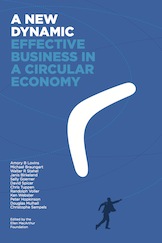
A New Dynamic - coverThe footnotes include a link to ‘Booms and Boomerangs’ – our January review of ‘A New Dynamic’ (the set text for MBA students at the Bradford University School of Management) and other material from the Ellen MacArthur Foundation.


Cutting Red Tape – lengthways?

8 Mar

hi=-tech buildingOur editorial – ‘Unbalanced Economies‘ – considers the dilemma of would be devolutionists as they grope for government policies that might ease the woeful inequalities of local economies across the UK.

There’s no lack of awareness of the growing gap between the growth of London and the UK’s other major cities.  It’s not just about jobs.  The impacts are evident in health, education, culture, innovation, and umpteen aspects of society –  and there’s no denying the dependence of local economies on centralised purse strings with stringent controls on spending anywhere that seems electorally risky.  Nor would the Whitehall wizards deny the export potential for technologies that claim to make cities smarter – though they shrink away from encouraging innovative aspirations in the underlying digital infrastructure investment.

But solutions are not to be found in more top-down initiatives.  If pushed the Whitehall policy police might perhaps concede that fostering maybe two provincial city hubs might be sustainable but such half-hearted measures fall way short of the natural aspirations bubbling up in places large and small across the country.

Enter the RSA’s City Growth Commission.   No debate better captures the red tape that ties central policy development in knots and exposes how the digital economy is delightfully disruptive.  Cutting the red tape lengthways is simply not good enough.

Full story here

And the last word goes to – Vodafone and a British Engineer – for Fibre

20 Feb


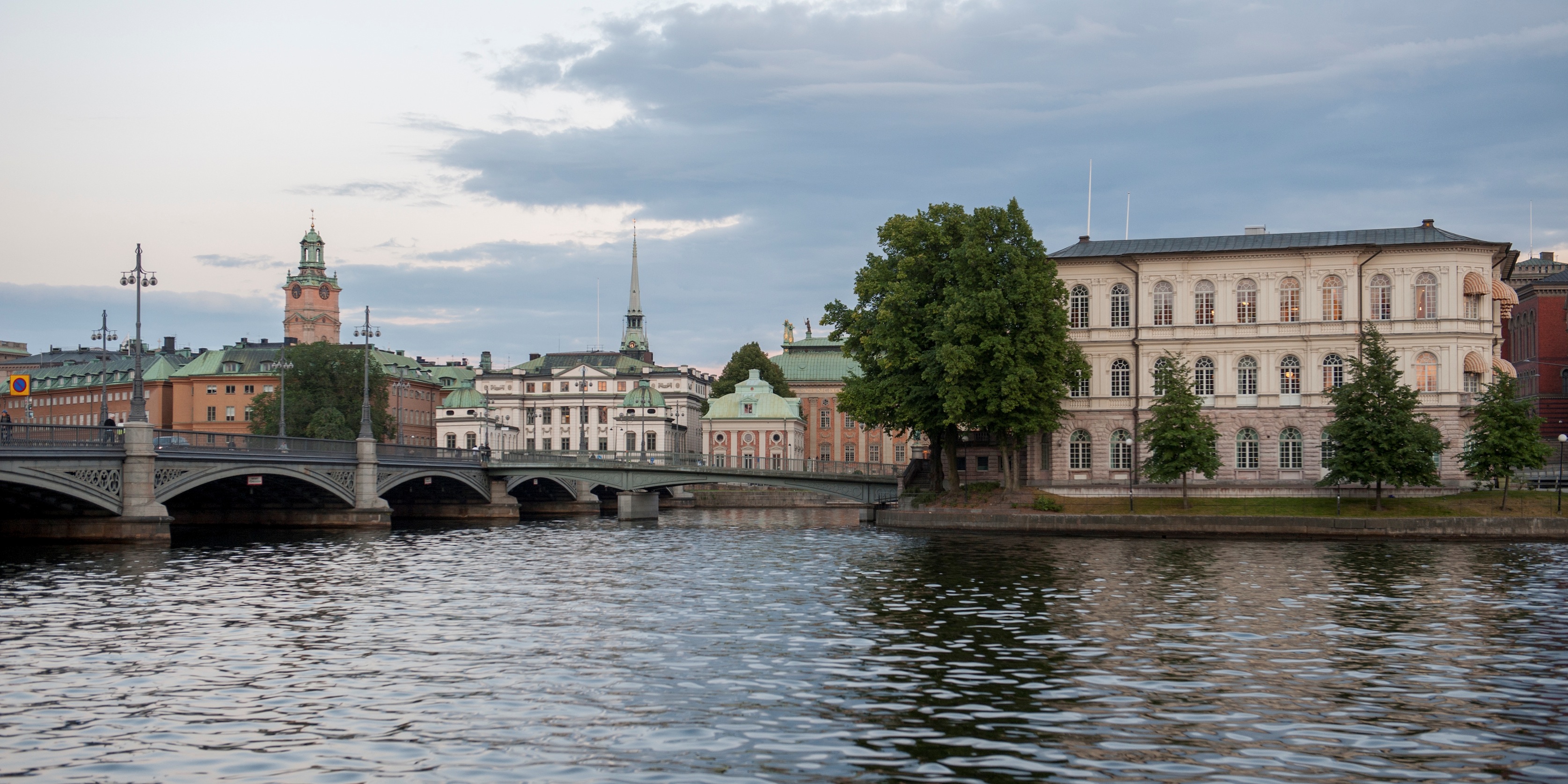
Stockholm Waterfront - smaller

FTTH Council Europe today honoured both Vodafone and British-educated Sir Charles Kao for their great achievements in fibre.

Full story here


UK and Germany sticking with a low fibre diet

20 Feb

FTTH logoFor a country that has just celebrated gaining an Olympic Gold medal for sliding faster down slippery slopes, this is a good time to pause and reflect whether the UK is playing in the right league.’

That’s the bottom line from our observations following the publication of the FTTH Council’s latest review of market development.

Full story here

FTTH Council Europe opens in Stockholm

19 Feb

Stockholm Waterfront - smaller


Listening this morning to the welcoming addresses by Anna-Karin Hart (Sweden’s Minister for IT and Energy) and the Mayor of Stockholm it became abundantly clear that the role of Municipal Enterprise has played a huge part in their country’s success.

Full story here.

Next Generation Digital Challenge Awards 2014 – Open Call launches on Wednesday

17 Feb

Stockholm Waterfront

The nomination form for this year’s Digital Challenge will be launched on Wednesday 19th Feb while we are in Stockholm at the FTTH Council Europe’s annual conference.

Anyone will be able to propose any UK digital project or team for wider recognition.   Entry is free.  Short-listed Finalists will be announced in July.

The awards ceremony will held in November.

More details will be posted on the Groupe Intellex main site and at NextGen Events.

Smart Communities Celebrate as ICF declares Global Top 7

24 Jan

The Intelligent Community Forum has announced the 2014 Top7 Intelligent Communities of the Year. The Top7 list includes three from Canada, two from the United States, and two from Taiwan.

Columbus Skyline 2This year’s Top7 group is unusual in that they represent only three nations but they have set a course for others to follow.  Each made it to the list by demonstrating how they have begun to fuse technology, culture and collaboration for economic sustainability.

In alphabetical order, the 2014 Top7 Intelligent Communities are:

  • Arlington County, Virginia, USA, which is building its own fiber network to boost broadband service and re-energize government-business-university collaboration
  • Columbus, Ohio, USA, which in its recovery from the 2008 recession has 20,000 more jobs than it did at its last economic peak in 2007
  • Hsinchu City, Taiwan, the first city in Taiwan to implement e-learning platforms for its students and establish a science park
  • Kingston, Ontario, Canada, which leveraged its educational institutions to build an innovation economy focused on environmental sustainability
  • New Taipei City, Taiwan, a new city forged from communities surrounding the nation’s capital, which is creating a unified and dynamic knowledge economy
  • Toronto, Ontario, Canada, with a renowned waterfront development that will provide Internet at 500 times the speed of conventional residential networks
  • Winnipeg, Manitoba, Canada, where reinvention of its agricultural legacy is creating strong growth while preserving a valued heritage

Study after study notes that cities all over the globe need solutions to a wide range of problems from transportation and the environment to economic growth and education. Intelligent Communities provide solutions.

Regular readers of this blog may not be entirely surprised to find that no UK communities are featured in the Global Top 7.   To be amongst these selected finalists and on course (after the next round of intense scrutiny) for the ultimate 2014 accolade in June, they would already have needed to qualify for the Top 21.

The entire point of submitting to the rigour of the Intelligent Community Forum’s process is to learn.  Some communities find great value in participating in successive years as they invest in the development of their local economies and establish themselves on the global stage.

We know that despite relatively meagre public funding resources (compared to their global competitors), the UK’s major city economies beyond London already generate a high proportion of national GDP growth but are expected to respond to significant pressures on housing, infrastructure, health, education (particularly in digital and vocational skills), enterprise innovation and community development.  The due diligence of potential inward investors demands that risks of failure are fully exposed.

As nations or regions we may be justifiably proud of great past achievements and glorious contributions to societal endeavour but not all ideas are invented here.  In a more digitalised era the new competitive advantage is so often a collaborative advantage.

If leaders of enterprising communities across the UK seek to emulate the success of others, ICF’s Top 7 global exemplars provide a deep pool of experiences and insights – and a great focus for our next fully managed Study Tour when we join them in New York in the summer.

For more details contact

← Back

Thank you for your response. ✨