
Converging or Diverging? Untangling Regulatory Directions

14 Nov

Over complex regulation is a nightmare for policymakers who want to move forward and a gift for corporates bent on ‘regulatory capture’.

Teasing the tangled remits apart is the best bet for governments who wish to focus the regulatory effort where it is most needed for the delivery of national imperatives.

Ahead of debates next week at ITU Telecom World 13 in Bangkok we reflect on the mixed motivations of communications regulators and the expectations of their governments.

Full story here

RSA City Growth Commission calls for input

12 Nov

Cities, inevitably, grow – but they do not always prosper.

The RSA’s City Growth Commission has set itself the task of asking ‘why?’

‘Multi-polar growth’ is their adopted term for a thinking about a less-London-centric rebalancing of the UK economy.

The Commission will no doubt garner views from umpteen shades of city advocate opinion.

Groupe Intellex has sent the Commission a response to all of their seven questions – and added an extra one for good measure.

City Growth Commission V4

A good week for digital diplomacy?

11 Nov

With so many revelations flying around this may seem an odd time to suggest it’s been a good week for digital diplomats.

In our observations of the past week (‘Digital Diplomacy: what goes around, comes around’) we note that even the Foreign Office is not unaffected by the Digital Economy.


Not symmetric, not fast, not super, not fibre – and not relevant.

29 Oct

hi=-tech buildingThe ‘Cities-are-Supreme’ brigade gathered for the RSA’s Cities Growth Commission launch yesterday.  They seemed oddly united in their view that rural dwellers should accept relative broadband poverty and stop whining.  The city enthusiasts may be searching for economic growth but curiously they overlook the poverty of digital infrastructures within their own cities.

Thirty years ago, as a young teenager, my son watched TV ads with far greater interest than he summoned for any of the programmes.  Eventually he concluded that you should always ask, ‘Why are they telling me this?’

In the late 1800’s an early expert in the new field of advertising reckoned that the message should be delivered 20 times before it gained acceptance.   From childhood we know the power of repetition.

It may be heroic engineering to squeeze a little data through a copper wire designed to do something completely different but that alone is no cause for celebration.

It may be commercially ‘prudent’ to avoid paying tax (and a tad less than communitarian or socially responsible) and it may be ‘convenient’ to overlook the provisions for asset replacement funding but we should not celebrate this prudent convenience – we should ask, ‘Prudent and convenient for whom?’

Next year no doubt someone will come up with the idea of ‘celebrating’ the 30th anniversary of the privatisation of British Telecom.  For free market enthusiasts the timing was fortuitous.  They got it off the government books five years before the penny dropped and digital communications became understood as an essential utility.  But no matter – we could pretend that we now had choice.

Even better – now we had a market we could also have a market regulator.  Oftel did a really great job – determinedly reducing prices (remember RPI-x?) and, as the incumbent felt so squeezed, the regulator very reasonably allowed that an irreducible part of their line rental charges should compensate for their need to fund the replacement of the ageing copper network on an 18-year basis.

By that reckoning we should by now all be benefitting from an access network rebuilt nearly twice over but, curiously, it seems not to have happened quite that way.   Far more convenient it seems to try and squeeze digital data down copper wires and extract much value as possible from the legacy analogue network before anyone suggests that the emperor is not wearing any clothes.  Yes, we are back to children’s stories and endless repetition. These clothes are super. They are fast. Say it often enough and folks will buy it.

Fortunately we are blessed with children who do not buy it.   They know that these clothes are not woven with fibre.  They know they are not fit for purpose.  They know that muddling through with not do.  They know that so-called ‘fibre broadband’ is not fully fibred, is not super, is not fast, is not symmetric, is not future-proofed and is not relevant for they way we live now.

They also know that they’ve been massively let down by a generation who trusted too much and did not dare to ask, “Why are they telling me this?”

The City Growth Commission will ask lots of questions – mostly about empowerment of cities, their leadership and their capacity to prosper.  In gathering evidence they’ll not apparently be asking, ‘Where are the UK’s Gigabit-Cities and who is building them?

Next Generation Digital Challenge Awards 2013

15 Oct

The applause has died down,  trophies carried home with pride and certificates most probably now being framed and mounted on office walls across the country – this year’s Digital Challenge Awards programme is finally over.

Our congratulations to all the Finalists, the runners-up and the trophy winners in each of the six categories.  Perhaps even more important than last night’s awards ceremony were the two conference sessions at NextGen 13 when 20 of the finalists presented vignettes of their work. The real impacts of the digital economy were on display – lifting delegates’ minds from the ongoing battle-front for better broadband and delivering  great and diverse examples of what it all means for ordinary people and businesses.

They may only have been a runner-up in the Digital Skills category but Rachel Barratt of Enfield Libraries was a star as she recounted how six-form students were patiently helping the over 50’s – and how both the youngsters and the elderly benefitted from the experience.   This ‘intergenerational project’ was just one example of how Tinder deserved to win the main award – the Tinder Foundation’s ‘learn my way’ course fuelled the Enfield project but Tinder actually scooped the prize for their Digital Housing Hub.

These and other stories are now available online .

Congratulations to all the winners and thanks to everyone who took part.

For a flavour of the NextGen 13 conference see the excellent coverage by ITProPortal or visit NextGen 13.

The Normal Diversity – Internet Study lays bare the digital realities

3 Oct

OxIS report cover For 10 years the Oxford Internet Institute has been studying the phenomenon of recent times; watching online activities grow, spreading into all corners of the UK’s economy & government and changing the way we all work, learn and play.

For 10 years they have charted the emergence and fluctuating fortunes of innovative services, new devices that make their usage easier, the gradual growth of better broadband access networks and the shifting demand for digital skills matched to global opportunities.

Now in their 10th year the researchers have concluded that the Internet is normal.

Not only is it normal – no longer in any way a remarkable phenomenon – but it seems, in our diverse attitudes to it, to be comfortingly reflective of the major personality traits of the population.

The 2013 OxIS report maps five distinct cultural groups amongst the 78% of the population who are in some way digitally touched.  These groups range from the wildly enthusiastic (the ‘e-Mersives’) through to those who are distinctly uncomfortable about the Internet (the ‘Adigitals).
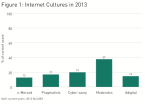
OxIS 5 cultures In our generally tolerant island population, 37% of Internet users, the largest single group, are classified as ‘cyber-moderates’ – accepting the benefits but moderate in both their hopes and fears.

The groupings do not, apparently, align with age demographics, life-stages, socio-economic classifications, employment status, or even the long-standing notion of ‘digital natives’ that youngsters born during this era are universally enthusiastic Internet adopters.  Moreover there was no evidence that these Internet Culture classifications were unstable despite a small drop in the proportion of users who believe there is too much immoral material online.

But they also imply a warning for a government pinning hopes for economic recovery rooted in UK on-line success.  The three more-enthusiastic culture groups may not yet have the scale to fuel internationally competitive growth.  It provokes a question – how can ‘Cyber-Moderates’ and ‘Adigitals’ become more engaged, and are we not all constrained by access infrastructures?

Slightly more controversially, and probably counter-intuitively for bloggers and blog-readers, researchers found a distinct cooling of enthusiasm for Social Media.  This effect may however be explained by the research methodology not perhaps moving fast enough to catch the trends towards newer Social Media services – or simply that the noise of the Internet is generated by relatively few very active users and more than balanced by the great and growing weight of ‘Cyber-Moderates’ and ‘Adigitals’.

Observers with a more global perspective such as Robert Bell of the Intelligent Community Forum point out that there are marked differences between the usage patterns of countries and even between different States of the USA.  Although not part of the OxIS work, researchers who probe the diversity of behaviours evident in populations of different countries will be fascinated by the parallels between the widely accepted Five Factor Model of personality traits and the OxIS five cultures of the Internet.  Both Robert Bell and OxIS report co-author Professor William Dutton will be speaking at NextGen 13 at Wembley (October 14th & 15th) and we can expect to hear a great deal more insight into this quite complex study.

Other highlights of that 2-day event include many new topics that one might not expect to hear at a conference (now in its 6th year) that was originally founded to campaign for better broadband infrastructure investment.  Those battles are still being fought, particularly away from urban centres, but the acknowledged pervasiveness of the Internet leads directly to concerns about digital skills, collaborative creativity, the openness of data and the plight of the 20% who, according to OxIS, have not yet encountered the Internet at a time when it has become pervasively normal and an increasingly essential utility.

It’s no great surprise, then to find that the NextGen 13 team has themed this year’s conference ‘Changing Agendas: shifting broadband futures’.  The oft-used term ‘Digital Economy’ becomes redundant now that the pre-qualifier ‘digital’ is no longer a significant differentiator within the entire UK economy.

If folks want to understand the nature and diversity of what it means to be British perhaps they need only to look at our diverse attitudes to the Internet and what it is to be normal?

____

NextGen 13 is a 2-day conference and exhibition at Wembley on October 14th and 15th 2013.

For details of the agenda, speakers, exhibitors and registrations please refer to the website.

Waiting at Wembley for Winners

30 Sep

wembley-imgIt’s always a tense time two weeks before any big conference event.

Right now the build-up to NextGen 13 is no different as the pace and pressure of programming for the conference builds.

The pressure may be even greater – not least because the 2013 themes are different in many ways.  One of the downsides for a conference series that’s enjoyed a long run (it’s the 6th year for this two-day event) is that many of the players must get up to speed with the changing agenda.   The annual conference reflects the topics of its time – not the battles of the past.

It is much easier for the speakers.  Recruiting them involves ensuring that they are relevant and have something new to contribute.  Exhibitors, all no doubt leading busy lives focused on their own rationales, only wake up to new themes at the eleventh hour.  Maybe this annual event provides a time for reflection – a chance to check alignments with market realities?   And delegates?  The regular attendees will once again be shocked that the agenda has shifted and newcomers will be intrigued to find they are not alone in their recent penny-dropping digital discoveries.

Amid the hectic noise of last-minute programme adjustments and choreography there’s one small corner where silence has momentarily settled.   The Digital Challenge jury is out and until 14th October fingers may be crossed but no one will tempt fate by speculating on winners.  Even here, in the Digital Challenge awards, the shifting agenda is apparent.  Three new trophies signal the importance of Skills, Innovation and Open Data – key topics that rise above the basic broadband battles.

The 2013 NextGen focus is not, of course, a secret.  Last December’s paper on ‘Economic Revitalisation’ set the scene.  The conference theme, ‘Changing Agendas: Shifting Broadband Futures’ was proclaimed earlier in the year along with an expansion of five topics that have since informed the final schedule.  And locating the event at Wembley itself carries a massive message about regeneration.  Delegates have options to visit the Stadium, the Arena backstage, local fibred premises and even Brent Council’s new Civic Offices to understand the realities of fully fibred networks and designs for sustainability.

Pulling it all together may be hectic.  Fitting all shades of opinion (and a fair few technologies) onto the platform and into the exhibition will demand another two weeks of patient attention to detail.  And the winners will be found in all those who change their agendas to meet the shifting demands of the UK’s digital economy.

___________________

NextGen 13, October 14th & 15th, at the Wembley Hilton, London, is the UK’s leading event for Next Generation broadband activity

This annual landmark event will build on Digital Scotland 2013 and the Intelligent Cities conference (Leeds) – events also managed by NG Events Ltd.

NextGen 13 provides the focus to take forward the UK’s digital access and application requirements debate. An exhibition and trade show will run alongside the conference.

Registration for Delegates

And finally – well almost finally – well, just another 38 days to go

5 Sep

Here in the early morning, the sun only just above the horizon, this extraordinary feeling of calm will surely not last – so there’s every reason to gently coax continuing slumber like a dream that you’d rather not let go.  Reality will make itself felt soon enough.

One by one the clamour of action points, promises, the sins of omission, the list of ‘things to do today’, will break through but right now there is space and time to think; to reflect that it’s nearly a month since that last blog note which, in retrospect, signaled the start of frenzied activity.

There are, no doubt, some well-ordered folks whose passage through life proceeds at a carefully moderated pace with commas in all the right places, no excessive use of capital letters or exclamations and with upright thinking always on an even keel.  They must be very boring.  Most of us are blown about by the winds – our progress being the aggregate of umpteen diversions, a touching faith in our navigation, a strong hand on the helm and another glass of red wine.

This current calm descended yesterday mid-day and marked the end of an intense month – perversely that month when so many folk push off for a rest.

It was the month when the short-listed contenders for this year’s Digital Challenge are converted into a complete set of final submissions to the judging panel.  It was the month to confirm the availability and willingness of the judges.  A month to redesign the scoring methodology and contemplate trophy designs.  It was a month of double-checking that the ideas flowing from the contenders would be fully reflected in the emergent agenda for NextGen 13 in October.  And yet this was only a small part of the annual orchestration of speakers, exhibitors, venues, sponsors and the briefs for session leaders – a massive workload (and risk) that falls on the remarkably resilient shoulders of colleagues Marit and Andrew.

But here, just for this short moment, it is calm.  The Digital Challenge entries are in the hands of the judging panel for the next three weeks.  Weather forecasters predict that this summer sun will end abruptly tomorrow with a 10-degree drop and the onset of autumnal rains.   And with the cold showers of tomorrow’s reality we must shake off this dull sloth and move on.

For those of you who’ve been away on holiday – welcome back.  The countdown to NextGen 13 has begun.  This year’s event will be at Wembley and while we are preparing the pitch, prizes and programme it will be the mix of delegates, speakers, exhibitors and sponsors who will come together to make a great event, Changing Agendas: shifting broadband futures’.

YEEKS – only 38 days?!

Digital Challenge Awards 2013 – record entry shows sources of economic growth

6 Aug

The UK’s Next Generation Digital Challenge is an annual awards programme that culminates in an award ceremony in October – this year at Wembley during the NextGen conference.

The entries this year are interesting for at least three reasons.  Firstly the Open Nomination phase resulted in more than three times previous entry levels.  Secondly analysis of the entries showed that there were now sufficient entries to justify support for three new categories – in Open Data, Digital Skills and Digital Innovation – in addition to the traditional categories for digital network developments.  Thirdly the entries show an increasing awareness of the value for local communities and the economy of long-term investment in digital infrastructure.

With this higher level of entries, up to six nominations in each category have now been selected  to go forward as Finalists for assessment by an independent judging panel and all of those short-listed will be invited to make brief presentations at NextGen13.

Full story including the short-listed Finalists here

There’s no smoke but maybe some learning is burning?

21 Jul

learning is burning jpegThere’s muffled murmuring in the background but no loud music, no unexpected truck or post deliveries, no obvious waste or smell and, amazingly, no significant demand on the Bank of Mum & Dad, but surely there is something going on in there.

It’s clearly not a complete secret – judging by footsteps on the stairs and occasional giggles – but she’s not for telling us, leastways not yet.

Ma says she should get more air. ‘Not good to be cooped up in that room all day’.   I’d like more conversation during meals but often now she doesn’t show up and when she does join us we get evasion and ‘you wouldn’t understand’.  Does anyone really need earphones at breakfast?

It’s clearly important, this life-changing stuff but the only way we can help, it seems, is to give the space, not ask annoying questions and make sure we all have even more connectivity.

This trust, this faith we have, this uncertainty is being tested.  Even her ‘what would he know’ older brother, has no clue and has resorted to casting aspersions.  But he’s off to uni in few weeks so, blessed relief; at least we’ll not have to endure that sibling rivalry.

‘Really, you should have a word’.  ‘Why me?‘ Parental Ping-Pong, batting back and forth, is a game for reluctant players.  ‘About what?‘  ‘What if?

The small mysteries of the digital revolution can be happening anywhere.  How things can flip from lonely localised passion to global success, how those tiny tweaks can make a huge difference, can never be explained.

Her only guiding rule, it seems, is “Screw it – let’s do it”, or, more forcibly, “Just (F) Do It”, or as we old stagers marvelled back when Net was new, ‘ Innovation Without Permission’.   That ‘so last century’ constraint of seeking permission does not now trouble young digitally liberated minds.

So relax, rejoice in their empowerment.  The world has moved on since some of us threw away the brakes of copper-constrained wires.  There is no going back.  Sit back, enjoy the ride, and hope they make a better job of it than your own tentative last generation efforts.

_______

If you made any sense of this try ‘Spot the Link‘ at our main editorial website.