
Tag Archives: NextGen

ICF Global Summit – Part 2

19 Jun

tumblr_inline_nq2npvt2RU1qczte2_500

For a broader summary of the events in Toronto last week I defer to ICF’s Norman Jacknis and his highlight selections at http://bit.ly/1GlyCy6

The concentration of ideas, perspectives and opportunities to meet with mayors and civic leaders from around the world was brilliantly refreshing.  Every year we find ourselves lifted above the fray – once again proving that a ‘retreat’ is most often an advance.

The inspiration from this year’s gathering in Toronto will hugely inform our work on the agenda for NextGen 15 in London and our Digital Challenge Awards event in the House of Lords on November 5th.


ICF Global Summit Perspectives: the growth impacts of policy polarisation

15 Jun

TorontoReflecting on a stimulating week of powerfully concentrated insights and great inspirations, delegates at the 2015 Intelligent Community Forum’s annual Global Summit might well have spotted the irony of making hard choices between the competing Urban and Rural study streams.

In this gathering last week in Toronto, Mayors, Civic Leaders, Economic Developers and Policy Influencers from around the world would represent both intensely Urban and some more Rural environments. In plenary ‘Community Accelerator’ sessions these camps would come together – united in their understanding of actionable attitudes to local growth and development – and yet, in choosing to engage in either the Urban or Rural Master Classes, delegates indirectly accepted that supposedly ‘normal’ polarisation.

For sure, there were some crossover delegates but for the most part the Urban stream was the better attended. From way beyond the bigger (supposedly brighter and more-urgent) connectivity conflict zones, delegates were treated to myth-busting moments showing that, even if it is harder to resolve, disregarding 50% of your economy does not add up to a sustainable growth strategy.

The universal over-arching growth perspective is what so often gets lost in the demands for policy attention from increasingly pressured places with claims for ‘economies of scale’ and the massively complex infrastructure needs of metro-dwelling citizens.

Above and beyond urging stronger advocacy from less-favoured places, or even the creation of ‘Virtual Metros’ to notionally level the playing field, surely policies to provide future-proofed digital infrastructures (and the stimulus that they enable) should everywhere be rooted in the drive for the economic and social well-being of local citizens and enterprises.

In the race to be recognised as the Intelligent Community of 2015, the surviving Top 7 communities (whether large, small, urban or rural) understood long ago that long-term (10 – 30 year) commitments to their economic well-being needed a consistent strategic approach with evolving local leadership and attention to local needs. These local issues are largely beyond the macro interventions of national governments and Party politics.

It is ironic that such an approach can be described as ‘Revolutionary’. Surely that tag is an indication of the extent to which folks and their communities now need to reassert control of their local direction.

So much more can be said of this ICF Global Summit, the underlying international quest for community recognition and the intensity of the associated Study Tour experiences.

Horseshoe FallsThe urgent rush for change, the inevitable need to adapt our communities to the utility of a digitally mediated world, was no less impressive than the forces of nature we experienced at the nearby Niagara Falls.


_________________

NextGen 15 – the UK’s 8th annual networking event to inform local government policy and provide a platform for the broader broadband sector will be held on November 5th in central London.

NextGen Events (an ICF Partner) and director Marit Hendriks is an international juror for the assessment of the Intelligent Community of the Year – awarded this year to Columbus, Ohio.

David Brunnen’s contribution to the 2015 Global Summit was based on the Groupe Intellex paper ‘Global Trade Development Outwith the Metros: not beyond belief’.


What we all know

7 May

What we all know . . . . . is mostly based on old assumptions that may well have been rendered obsolete.   Evidence-led policy/decision-making may limit forward thinking but at least it doesn’t negate the need for ‘reviewing the situation’.

This need for current evidence is hugely important to local authorities as they seek (or are given) more responsibility to support their local economic growth.   Empowerment, devolution and decentralisation are all in the melting pot for any new government – and the currency of the evidence base is particularly important in policy areas where the fundamentals are rapidly shifting.

Fiber optics

Fiber optics

Take, for example, what we know about investment in future-proofed Fibre to the Premises (FTTP) broadband infrastructure. What we all know is that it’s horribly expensive, of dubious viability and there’s uncertainty around whether folks really need it.  BUT, what we all know is largely based on analysis that was produced more than a decade ago – analysis that some would say was a wee bit suspect even back then.

How important then is it that Local Authorities seeking to spend public sector funds on digital infrastructure are fully aware of cost reductions, improved deployment managements, dramatic shifts in uptake of better services and the scope for increased revenues for network operators and dividends for investors?

It should not be a surprise that the old ‘rules of thumb’ have shifted a bit – and it should be no surprise that hindsight reveals the unintended consequences of now-outdated motivations.

By bringing together best-practice experience from our own and other countries new models for investment can now be considered – and, moreover, considered in the context of what we can now deduce will be future requirements.

Based on his multi-country experience, Richard Jones, Chief Commercial Officer of VentureNext, has offered has offered to share an interactive business model that illustrates some of the challenges with investment in FTTH. Knowledge sharing in this arena is beneficial for all parties – investors, suppliers and citizens – and provides a way to refresh ‘what we all know’ in this vital area for future economic growth and societal development.

Further details

2015 NextGen Digital Challenge Awards – Nominations close 29th May

14 Apr


Idea

The Open Call for entries in the 5th annual NextGen Digital Challenge Awards programme has already attracted some great ideas from across the UK.

In addition to the original categories for innovations in City, Urban and Rural Broadband Networks, Open Data and Digital Inclusion, the 2015 programme includes opportunities for projects in the ‘Sharing Economy’, Digital Health and ‘Municipal Enterprise’.

A full list of the Awards Categories is available together with details of previous winners and short-listed Finalists.

The Open Call closes at the end of May and the 2015 short-listed Finalists will be announced in June. Nomination is FREE.

The independent judging panel will review the Finalists in September.

Winners will be announced on November 5th at the Awards Dinner hosted by Lord Merlin Erroll in the House of Lords, Westminster. The celebration follows the NextGen15 Workshops & Trade Fair.

Sponsorship opportunities for some Awards Categories are still available – contact: Marit Hendriks via awards@nextgenevents.co.uk or call 07734 919479

NextGen Academy brings Ventura’s FTTH Investment Workshop to the UK

3 Apr

For UK readers who were unable to trek to Warsaw in February, NextGen Academy has arranged a special treat next month in London.

Richard Jones websized

Like so many delegates, our journey to the 2015 FTTH Council Europe’s annual conference was enlivened by VenturaNext’s mini-MBA led by CCO Richard Jones.  In the space of just a few hours delegates already familiar with well worn arguments about investment in fibre access networks woke up to a realisation that those old familiar rules had shifted.

With input costs down, demand up, network planning & deployment management honed and growth outcomes valued more highly, it is time to rethink the decisions that have led many investors to limit risk through severe design compromise.

That is why a re-run of this great workshop is so timely for a UK audience – but delegate places are limited and priority must go to  Municipalities concerned for their local economic growth and City Analysts who are called to back new market entrants.

The event on May 19th in central London is not free of charge – but fees have been kept as low as possible with a 40% discounted rate for public sector attendees.

REGISTER HERE

OPEN CALL – NextGen Digital Challenge 2015

1 Feb

NextGenAwards2015600


The NextGen Digital Challenge Awards programme is back for a 5th year.

Launched today, the Open Call for nominations from across the UK and the Republic of Ireland seeks great examples of digital endeavour.

Whilst mainstream media focus on big names and even bigger numbers, the real impacts of  increasingly digitalised economies are often found at a more local level.  In 2015 the Awards categories will now include the ‘Sharing Economy’ and ‘Municipal Enterprise’ – arenas where direct impacts for people and enterprises are massively transformative.

Join us on this journey of digital discovery by nominating projects and achievements that deserve recognition. Nomination is free of charge.

Full details at http://www.nextgenevents.co.uk/awards

See also ‘And your point is?

NextGenAwards2015600

Unleashing Municipal Enterprise: stimulating economic growth in the digital era

4 Nov

helix websizeA new Groupe Intellex paper urges greater empowerment of UK municipalities to take a stronger role in developing their local digital infrastructures as a foundation for future economic growth and community development.

The graphic selected for the front of this paper shows the double helix representation of DNA – the stuff of life.

The shot was taken from the chapel of the research institute of the hospital of San Raffaele in Milan.

The message is that digitalisation is now deeply embedded in the DNA of modern economies.  The Digital Economy is a term that is now almost redundant; what part of economic activity is not in some way facilitated or enabled by digital networks and technologies?

The paper draws together several threads – calls for devolution, new insights into the efficacy of public investment and demands for smarter attention to local needs – and contrasts the centralised state supervision of the UK with progressive communities across the world.

The topic will be discussed at NextGen 14 Fast Track to the Future conference in Derby (November 11th & 12th).

Unleashing Municipal Enterprise  (3MB PDF download).

Video interview from NextGenTV

Toronto Triumphs as 2014 Intelligent Community awarded at ICF in New York

8 Jun
Intelligent Community Forum

Intelligent Community Forum

The climax of the 2014 Intelligent Community Forum’s annual summit  came as the ICF Top7 communities, their leaders and mayors from around the world gathered on Thursday night for dinner in New York.

The gathering also heard from Suneet Singh Tuli – Founder of DataWind and ICF’s ‘Visionary of the Year’.

In one sense all of the Top7 Communities were winners simply by taking part in the intensive ICF process but ultimately there could only be one winner – and it was Toronto that triumphed.

But the Summit was far more than just the award of the ultimate accolade.  Throughout the week Mayors and Civic Leaders from Europe, Asia, Australia, New Zealand and North America have shared their experiences and gained great insights in economic and societal development.

Full story here

Developing the Economic Fabric of the Future

5 Jan

Thinking about the prospects and projects for 2014, several development themes seem likely to be woven into the complex economic and community development fabric.  

One of our great insights from last year came from the CIO of the City of Chattanooga in Eastern Tennessee as he explained his rationale for investment – a process that resisted the technology-driven desires and preferences of the IT industry and focused ruthlessly on the real objectives of his municipal client departments.

This, in the USA’s first ‘GigabitCity’ where connectivity and capacity is not an issue, reflected a determination to deliver real benefits to the City’s administration (and  consequently its citizens and tax-payers) without wasting the rich resources available.  And in the Mayor’s office we found two of them – the City Mayor and the Mayor for the surrounding County.  Their mutual understanding of the interdependent role of the City and its hinterland added a fresh dimension to discussions of ‘Smart Cities’ that are so often reduced to Urban versus Rural contentions.

Immediately after visiting Chattanooga we spent time in New York with the Intelligent Community Forum (ICF) and, once again, their perspective on the challenges faced by communities around the world provided a new way of thinking about the priorities we give to economic development.

In The Fabric of Our Futures (PDF) we summarise some of the more obvious themes that will arise in 2014 and, hopefully, will inform projects and prospects for future Study Tours, the UK’s Next Generation Digital Challenge Awards and the platforms we organise for innovators and community leaders.

The full text is also available here.

The Normal Diversity – Internet Study lays bare the digital realities

3 Oct

OxIS report cover For 10 years the Oxford Internet Institute has been studying the phenomenon of recent times; watching online activities grow, spreading into all corners of the UK’s economy & government and changing the way we all work, learn and play.

For 10 years they have charted the emergence and fluctuating fortunes of innovative services, new devices that make their usage easier, the gradual growth of better broadband access networks and the shifting demand for digital skills matched to global opportunities.

Now in their 10th year the researchers have concluded that the Internet is normal.

Not only is it normal – no longer in any way a remarkable phenomenon – but it seems, in our diverse attitudes to it, to be comfortingly reflective of the major personality traits of the population.

The 2013 OxIS report maps five distinct cultural groups amongst the 78% of the population who are in some way digitally touched.  These groups range from the wildly enthusiastic (the ‘e-Mersives’) through to those who are distinctly uncomfortable about the Internet (the ‘Adigitals).
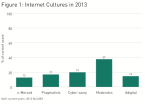
OxIS 5 cultures In our generally tolerant island population, 37% of Internet users, the largest single group, are classified as ‘cyber-moderates’ – accepting the benefits but moderate in both their hopes and fears.

The groupings do not, apparently, align with age demographics, life-stages, socio-economic classifications, employment status, or even the long-standing notion of ‘digital natives’ that youngsters born during this era are universally enthusiastic Internet adopters.  Moreover there was no evidence that these Internet Culture classifications were unstable despite a small drop in the proportion of users who believe there is too much immoral material online.

But they also imply a warning for a government pinning hopes for economic recovery rooted in UK on-line success.  The three more-enthusiastic culture groups may not yet have the scale to fuel internationally competitive growth.  It provokes a question – how can ‘Cyber-Moderates’ and ‘Adigitals’ become more engaged, and are we not all constrained by access infrastructures?

Slightly more controversially, and probably counter-intuitively for bloggers and blog-readers, researchers found a distinct cooling of enthusiasm for Social Media.  This effect may however be explained by the research methodology not perhaps moving fast enough to catch the trends towards newer Social Media services – or simply that the noise of the Internet is generated by relatively few very active users and more than balanced by the great and growing weight of ‘Cyber-Moderates’ and ‘Adigitals’.

Observers with a more global perspective such as Robert Bell of the Intelligent Community Forum point out that there are marked differences between the usage patterns of countries and even between different States of the USA.  Although not part of the OxIS work, researchers who probe the diversity of behaviours evident in populations of different countries will be fascinated by the parallels between the widely accepted Five Factor Model of personality traits and the OxIS five cultures of the Internet.  Both Robert Bell and OxIS report co-author Professor William Dutton will be speaking at NextGen 13 at Wembley (October 14th & 15th) and we can expect to hear a great deal more insight into this quite complex study.

Other highlights of that 2-day event include many new topics that one might not expect to hear at a conference (now in its 6th year) that was originally founded to campaign for better broadband infrastructure investment.  Those battles are still being fought, particularly away from urban centres, but the acknowledged pervasiveness of the Internet leads directly to concerns about digital skills, collaborative creativity, the openness of data and the plight of the 20% who, according to OxIS, have not yet encountered the Internet at a time when it has become pervasively normal and an increasingly essential utility.

It’s no great surprise, then to find that the NextGen 13 team has themed this year’s conference ‘Changing Agendas: shifting broadband futures’.  The oft-used term ‘Digital Economy’ becomes redundant now that the pre-qualifier ‘digital’ is no longer a significant differentiator within the entire UK economy.

If folks want to understand the nature and diversity of what it means to be British perhaps they need only to look at our diverse attitudes to the Internet and what it is to be normal?

____

NextGen 13 is a 2-day conference and exhibition at Wembley on October 14th and 15th 2013.

For details of the agenda, speakers, exhibitors and registrations please refer to the website.