Tag Archives: economy

Adapt or Mitigate or Rethink? Creating an environment for fresh thinking

31 Mar

On the day when a report from the International Panel on Climate Change (IPCC) has prompted headline writers to debate Adaptation versus Mitigation we highlight an altogether different approach – one that demands that we rethink the way economies work.

In ‘A few words about a Circular Economy‘ we consider the challenges of communicating fresh ideas in an environment where words like ‘green’ are no longer helpful.   New digitally-enabled capabilities are hastening the end of mechanistic ‘linear’ economics but expertise in understanding Whole Systems’ and ‘Ordered Complexity’ is only just emerging.

Our editorial gives just a glimpse of the potential for fresh thinking being pioneered by the Ellen MacArthur Foundation and comments on how we must also rethink our choice of words to describe the journey.

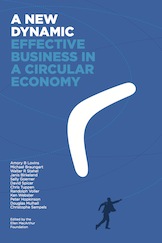
A New Dynamic - coverThe footnotes include a link to ‘Booms and Boomerangs’ – our January review of ‘A New Dynamic’ (the set text for MBA students at the Bradford University School of Management) and other material from the Ellen MacArthur Foundation.


Cutting Red Tape – lengthways?

8 Mar

hi=-tech buildingOur editorial – ‘Unbalanced Economies‘ – considers the dilemma of would be devolutionists as they grope for government policies that might ease the woeful inequalities of local economies across the UK.

There’s no lack of awareness of the growing gap between the growth of London and the UK’s other major cities.  It’s not just about jobs.  The impacts are evident in health, education, culture, innovation, and umpteen aspects of society –  and there’s no denying the dependence of local economies on centralised purse strings with stringent controls on spending anywhere that seems electorally risky.  Nor would the Whitehall wizards deny the export potential for technologies that claim to make cities smarter – though they shrink away from encouraging innovative aspirations in the underlying digital infrastructure investment.

But solutions are not to be found in more top-down initiatives.  If pushed the Whitehall policy police might perhaps concede that fostering maybe two provincial city hubs might be sustainable but such half-hearted measures fall way short of the natural aspirations bubbling up in places large and small across the country.

Enter the RSA’s City Growth Commission.   No debate better captures the red tape that ties central policy development in knots and exposes how the digital economy is delightfully disruptive.  Cutting the red tape lengthways is simply not good enough.

Full story here

A New Dynamic – effective business in a circular economy

24 Jan

A New Dynamic - coverAs the Ellen MacArthur Foundation crew headed to Davos they had at least two reasons to be cheerful; Unilever joining the foundation’s ranks of enlightened major players and the publication of their latest MBA textbook, ‘A New Dynamic’.

The Circular Economy concept has been well rehearsed  – notably in brilliantly animated productions for schools – and this new book is very much directed at graduates and business strategists.  It not only gives a thorough grounding in the concept’s gestation – how economies must move on from the wastefulness of outmoded ‘linear’ models – but also maps the scale of new sustainable opportunities.  This goes way beyond conventional recycling – it heralds both an entirely new way of designing products and the ways that these products (or the use of them) will be delivered to future consumers.

Converting the radical Circular Economy concepts into reality is a long term challenge that will increasingly be addressed by the enterprise managers of tomorrow.  Volatility in raw material and energy prices is just one of the drivers behind the shift from Ownership to Access and shifts in design to enable ‘things that are made to be made again’.

In ‘Booms and Boomerangs‘ we review ‘A new Dynamic’ in the context of Irene Ng’s ‘Value & Worth’ and John Kay’s recent RSA Journal essay ‘Circular Thinking’.

RSA City Growth Commission – deadline for submissions – 17th January

13 Jan

hi=-tech buildingAs the RSA’s Call for Evidence is set to close next Friday we were reminded to look back at how we viewed the Urban Regeneration scene in 2008 – just prior to the financial meltdown.   Such was the paucity of ground-breaking developments that we described Urban Regeneration as ‘a cottage industry’.

Now that the economic cycle is once again supportive of renewed hope for urban regeneration and there are calls for smarter (or more intelligent) cities and communities, it’s perhaps time to pick up those themes that now seem more than ever essential in the search for prosperous local economies.

Full story here

Developing the Economic Fabric of the Future

5 Jan

Thinking about the prospects and projects for 2014, several development themes seem likely to be woven into the complex economic and community development fabric.  

One of our great insights from last year came from the CIO of the City of Chattanooga in Eastern Tennessee as he explained his rationale for investment – a process that resisted the technology-driven desires and preferences of the IT industry and focused ruthlessly on the real objectives of his municipal client departments.

This, in the USA’s first ‘GigabitCity’ where connectivity and capacity is not an issue, reflected a determination to deliver real benefits to the City’s administration (and  consequently its citizens and tax-payers) without wasting the rich resources available.  And in the Mayor’s office we found two of them – the City Mayor and the Mayor for the surrounding County.  Their mutual understanding of the interdependent role of the City and its hinterland added a fresh dimension to discussions of ‘Smart Cities’ that are so often reduced to Urban versus Rural contentions.

Immediately after visiting Chattanooga we spent time in New York with the Intelligent Community Forum (ICF) and, once again, their perspective on the challenges faced by communities around the world provided a new way of thinking about the priorities we give to economic development.

In The Fabric of Our Futures (PDF) we summarise some of the more obvious themes that will arise in 2014 and, hopefully, will inform projects and prospects for future Study Tours, the UK’s Next Generation Digital Challenge Awards and the platforms we organise for innovators and community leaders.

The full text is also available here.

Whatever Next? Without vision the platforms perish

29 Nov

Underlying the froth of Application inventiveness lies a deeper, more fundamental, challenge for the true innovator – the creation of new enabling digital platforms to take over from tired designs that are nearing the end of their lives and can no longer be sustained by patches, fixes, makeovers and redecoration.

Full story here 

Unintended Consequences – and U-turn challenges

18 Nov

Thinking back to the summer of 2012, Michael Heseltine and his team made many good decisions. With an ear for political consensus he crafted a way to get things done – and made 89 recommendations.

It may now be increasingly beyond doubt that those right decisions were made for some of the wrong reasons – but does it really matter that some stones remained unturned?

Full story here.

A good week for digital diplomacy?

11 Nov

With so many revelations flying around this may seem an odd time to suggest it’s been a good week for digital diplomats.

In our observations of the past week (‘Digital Diplomacy: what goes around, comes around’) we note that even the Foreign Office is not unaffected by the Digital Economy.


From Nano-dots to Giga-blots

11 Jul

As a follow-up to our earlier note (28th June) on the questions that might be asked by the UK’s Public Accounts Committee when they consider the NAO report on broadband delivery, we’ve spotted another possible mind-mapping connection – the Federation for Small Business report on the value of local procurement.

In the minds of those who think that digital infrastructure is so complex that it can only be addressed by Mega Phone companies, the notion of locally designed and managed network initiatives might seem an unlikely concept.  Fortunately the economic experience elsewhere in Europe and the USA shows otherwise.

Our editorial, ‘ The great dot-joining debate‘, asks whether the FSB’s procurement report will be considered as an ignorable nano-dot or be a broadband Giga-blot when the PAC meets to take ‘expert’ evidence on 17th July.

Seeing the Value – will the UK Public Accounts Committee make the connections?

28 Jun

WestminsterIn matters of broadband policy many folks would not normally rate the chances of UK Parliamentarians having sufficient awareness to probe government policy to any great depth but in July their Public Accounts Committee will have the benefit of the National Audit Office report on the delivery performance of the Department of Culture Media and Sport – the current policy owner for the UK’s most critical infrastructure development.

The committee can, of course, give witnesses a fully televised hard time for the benefit of the wider public but much will depend on the members’ ability to ask incisive questions.   In their deliberations over the state of broadband policy the PAC will also have the benefit of the Information Economy industry strategy recently launched by the Department for Business (the former owner of broadband infrastructure policy) and, of course, the brilliant independent review of Public Sector Information by Stephan Shakespeare

Hearings of the Public Accounts Committee of the UK Parliament seem an unlikely platform for articulation of radical policy ideas.  The PAC may be regarded as ‘influential’ but in practice government can ignore its reports and the committee has no direct vote on policy issues.  At its best they can capture and deliver views that are of common concern – views and sensitivities that any government might be foolish to dismiss –  and this is why the combination of the NAO, IE and PSI reports is now so powerful.

Centre-right policy across the entire economy is firmly grounded in a view of competitive market efficiency that is so often a misinterpretation of its roots in the USA.    It is true that radical approaches to infrastructure provision in the USA have been routinely opposed in the courts with intensive lobbying from established industry interests.  That however has not prevented 135 municipal FTTP access networks from being deployed and is not deterring many others now in the throes of feasibility studies.  Indeed their regulator, the FCC, is actively encouraging the growth of new entrants to deliver local ‘future-proofed’ Gigabit networks – often in conjunction with local municipal Energy companies.

The reason for this municipal non-conformist economic behaviour is quite simple.  These cities and communities need jobs and economic growth – and someone has rumbled that the global market for the expertise that is engendered is not just huge; it is vastly greater than the growth prospects of an industry dedicated to limiting its own long-term growth in the interests of short-term market gains and value extraction from an outdated analogue infrastructure.

On the other side of the Atlantic the policy view of connectivity is analogous to their recently reframed position on Climate Change.  After years of resistance, after listening attentively to oil and gas lobbyists, realisation has finally dawned that the global market for sustainable energy is real, that climate change is real, and there’s an urgent need to gain qualifying experience if the opportunities are not to be missed.

Which is exactly the point made in the UK’s Information Economy industry strategy.  ‘UK Trade & Industry’ now understands that the global market for smart city management systems is worth around £400bn by 2020 and, if UK firms are to stand any chance of gaining a modest 10% market share, there’s an urgent need to have some sort of credible  qualifying experience.  So far only one UK city has made any real attempt to deploy an ultra-fast city network and, in a classically defensive and litigious response, BT and Virgin Media have opposed that initiative

The PAC may perhaps wonder why the Connected Cities programme is so lacking aspiration and urgency that the public funding is almost entirely ending up with established interests who are not keen to see citizens and enterprise provided with future-proofed fibre access networks.  They might argue the point from the view of Health, Energy, Transport, Environment, Education, Social Services or any departmental position that is now critically dependent on a fully connected digital economy.

They might even question the oddly antique view that the Information Economy is some small but growing sub-sector of UK industry – some clever clogs that do strange digital things – rather than the primary focus for revitalisation and rebalancing across the entire economy.

And, while they are rightly focused on public expenditure they might wonder about value for money for expensive public sector networks paid for by the public purse but not, it seems, allowed to be used for the benefit of citizens.

The digital penny may perhaps have dropped in a corner of the Department for Business Innovation and Skills but it is surely the Treasury that needs to understand the risks and true cost to an economy that cannot afford to prop up relics of the past.

_______

Related Links.

Searching for the Centre of the Digital Universe

Economic Revitalisation